Partner Margaret Llewelyn Davies
Queer Places:
Devil's Brg, Carnforth LA6 2DA, United Kingdom
St Mary the Virgin Church, Church St, Kirkby Lonsdale, Carnforth LA6 2AX, United Kingdom
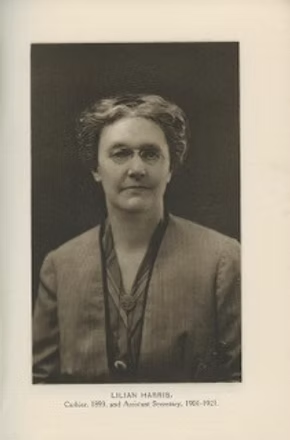 Lilian Harris (March 1865 - January 1950) was a remarkable British administrator, researcher, and pacifist who served as the Assistant Secretary of the Co-operative Women's
Guild and formed a profound, lifelong partnership with Margaret Llewelyn Davies.
Lilian Harris (March 1865 - January 1950) was a remarkable British administrator, researcher, and pacifist who served as the Assistant Secretary of the Co-operative Women's
Guild and formed a profound, lifelong partnership with Margaret Llewelyn Davies.
Born into a prominent family, she was the daughter of Alfred Harris (1826–1901), a wealthy banker, landowner, Justice of the Peace, and High Sheriff of Westmorland in
1885. Her father built the family estate Lunefield in Kirkby Lonsdale between 1869 and 1870 on the site of an earlier house, acquired additional properties such as the Holme
House estate in Tunstall, and established deep roots in the region alongside her mother and siblings, including her brother Theodore and her youngest sister Gwendolen.
The original mansion of Lunefield is no longer standing. After Alfred Harris built the grand turreted and crenellated Gothic Revival mansion in 1869–1870 (designed by the
renowned architect Alfred Waterhouse), the estate later fell into decline following requisition during World War II. Like many country houses of its era, it was ultimately
demolished in 1958. While the house itself is gone, a few traces remain today: Lunefield Drive, the modern street name in Kirkby Lonsdale preserves the property's name, and
a pair of the estate's original stone gateposts still survives near Devil's Bridge as a historical reminder of the lost mansion.
Despite her privileged background, Lilian's early life was marked by a stifling conventional upbringing with scant education, initially spending her time at home with
carving and embroidery. Her life shifted dramatically in 1889 when she met Margaret Llewelyn Davies, who had recently been appointed General Secretary of the Women's
Co-operative Guild and had moved with her family after her father took up a post at St Mary's Church. Seeking an outlet, Lilian began helping Margaret run the Guild office
out of the vicarage. When a trip to London resulted in Lilian falling seriously ill, her parents reacted with fury, labeling her incompetent and demanding that she abandon
her Guild work against their wishes. Demonstrating immense courage, Lilian defied her parents and continued working alongside Margaret, rapidly becoming indispensable as the
Guild experienced massive growth.
When her parents eventually moved away, Lilian stayed behind in Kirkby Lonsdale, eventually relocating to Hampstead in 1908 when Margaret's father retired, and later
moving to Dorking in Surrey. Recognized as a brilliant, quietly efficient administrator, she was officially designated Guild Assistant Secretary from 1901 and earned deep
affection and respect from activists who relied on her for organizational guidance. Beneath her unassuming exterior lay considerable intellectual gifts, enabling her to work
as a talented researcher and writer who produced various pamphlets later in life. Together, Lilian and Margaret formed a flawless organizational partnership for the Guild;
as Margaret Bondfield observed, Margaret provided the inspiration and driving force while Lilian served as the practical mind keeping everyone grounded in the possible.
Although quieter and more retiring than Margaret, Lilian was a strong, independent character who embraced the emancipated "New Woman" style of the 1890s by wearing
bloomers instead of petticoats, riding a bicycle, and later famously smoking a pipe. She shared Margaret's radical political ideals and stood firmly against the current
during World War One by adopting a pacifist stance. Following the death of Margaret's father in 1916, the two women lived together for nearly thirty years. While they
maintained individual independence with separate bedrooms and sitting rooms, they were widely seen as a couple and devotedly supported one another through the challenges of
illness and old age until Margaret's death in 1944. Lilian survived Margaret by six years, passing away in 1950 and remaining deeply engaged in the world and politics
despite dealing with blindness and deafness. Remembered by friends and acquaintances as an extraordinary example of the profound influence of a completely obscure person,
Lilian left behind a legacy defined by her steadfast dedication, administrative brilliance, and unwavering partnership.
References:
- The Personal Papers of Margaret Llewelyn Davies (1864–1995). Held at Girton College Archives, University of Cambridge (Collection Reference: `GBR/0271/GCPP`). Includes correspondence, biographical material, and documentation concerning Lilian Harris and their joint tenure and trusteeship with the Co-operative Women's Guild.
- Records of the Co-operative Women's Guild. Held at the Hull History Centre, University of Hull (Collection Reference: `GB 50 U DCW`). Contains central committee minutes, administrative records, photographs of Margaret Llewelyn Davies and Lilian Harris running the Guild centrally, and Freedom of the Guild documentation awarded to both women in 1922.
- Banks, Olive. (1985). The Biographical Dictionary of British Feminists: Volume 1, 1800–1930. Wheatsheaf Books. (Features dedicated biographical coverage of Lilian Harris, highlighting her background, her role as assistant secretary, and her life partnership with Margaret Llewelyn Davies)
- Gaffin, Jean, & Thoms, David. (1993). Caring & Sharing: The Centenary History of the Co-operative Women's Guild (2nd ed.). Holyoake Books.
- Cohen, Ruth. (2020). Margaret Llewelyn Davies: With Women for a New World. Merlin Press. (Examines the institutional platform of the Guild and the decades-long collaboration between Davies and Harris)
- Curtis, Mavis. (2017). What the Suffragists Did Next. Amberley Publishing.
Support this project
This website is a passion project researched, developed, and funded entirely by me. If you find the content valuable and would like to help support the ongoing research and hosting costs, any contribution is deeply appreciated.
Thank you for keeping this independent resource alive!
My books on Amazon: Elisa Rolle's books
BACK TO HOME PAGE